Underground excavations in Bedford represent a critical discipline within geotechnical engineering, encompassing the design, construction, and maintenance of subterranean spaces that range from utility tunnels and basements to large-scale infrastructure projects. The importance of this category in Bedford is growing as the town undergoes urban regeneration, with increasing demand for underground parking, stormwater storage, and foundation systems that maximise land use in densely built areas. Properly executed excavations ensure structural stability, protect adjacent buildings, and manage groundwater, making them essential for safe and compliant development in both residential and commercial sectors.
Bedford's geology presents specific challenges that directly influence excavation strategies. The town is underlain by the Oxford Clay Formation, a stiff, overconsolidated clay that can be prone to swelling and shrinkage with moisture changes, alongside superficial deposits of river gravels and alluvium along the Great Ouse valley. These conditions demand careful assessment of soil behaviour, particularly regarding heave potential, short-term stability in clay cuts, and water ingress in granular layers. A thorough ground investigation is mandatory to inform the geotechnical design of deep excavations, ensuring that temporary works and permanent retaining structures are appropriately dimensioned for the local stratigraphy.
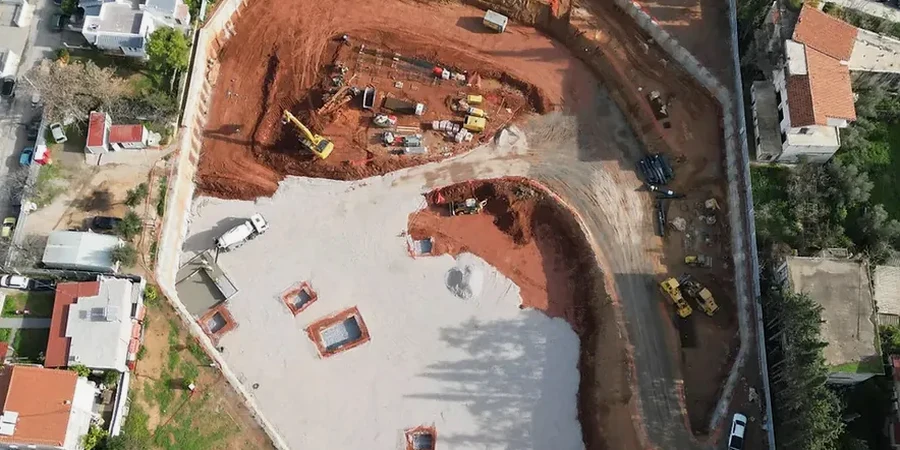
Compliance with UK standards is non-negotiable for any underground excavation project in Bedford. The primary regulatory framework is Eurocode 7 (BS EN 1997-1 and BS EN 1997-2), which governs geotechnical design through limit state principles, requiring assessments of ultimate and serviceability limit states. Execution is covered by BS 5975 for temporary works and BS 8002 for earth retaining structures, while CDM 2015 regulations impose strict duties on designers and contractors to manage health and safety risks. Additionally, the Party Wall etc. Act 1996 is frequently triggered in urban Bedford excavations near neighbouring properties, requiring formal notifications and agreements before work commences.
This category serves a broad spectrum of project types across Bedford's built environment. Infrastructure schemes such as the Bedford Western Bypass and town centre redevelopments rely on deep excavations for underpasses, culverts, and attenuation tanks. Residential and commercial developments increasingly incorporate basements and underground car parks, particularly where planning constraints limit above-ground footprints. Utility installations for water, gas, and fibre optics require trenchless techniques and open-cut excavations that must be carefully managed to avoid service strikes and ground collapse. During construction, geotechnical excavation monitoring plays a vital role in tracking ground movements, pore pressures, and structural response, enabling timely interventions if design thresholds are approached.
Quick answers
What are the main geotechnical risks associated with underground excavations in Bedford?
The primary risks include instability in Oxford Clay due to its fissured nature and potential for softening upon exposure, groundwater inflows from river gravels and alluvium near the Great Ouse, and ground movements that could damage adjacent structures. Heave at excavation base and collapse of unsupported faces are also key concerns that require robust temporary works design and continuous monitoring.
Which UK regulations apply to deep excavation projects in Bedford?
Eurocode 7 (BS EN 1997-1 and BS EN 1997-2) provides the overarching design framework, while BS 5975 governs temporary works procedures and BS 8002 covers earth retaining structures. The Construction (Design and Management) Regulations 2015 impose legal duties for health and safety, and the Party Wall etc. Act 1996 applies when excavations affect neighbouring properties.
Why is monitoring necessary during underground excavation works?
Monitoring is essential to validate design assumptions, detect early signs of ground movement or structural distress, and ensure the safety of workers and the public. Instrumentation such as inclinometers, piezometers, and settlement markers provides real-time data on wall deflections, groundwater pressures, and surface settlement, allowing engineers to adjust construction methods before problems escalate.
What types of retaining structures are commonly used for excavations in the Oxford Clay?
Common solutions include secant piled walls for deep basements where groundwater control is critical, sheet pile walls for temporary cofferdams in riverine areas, and soil nail or anchored systems for cuttings in stiff clay. The choice depends on excavation depth, proximity to sensitive structures, groundwater conditions, and whether the wall is temporary or permanent.