Geotechnical laboratory testing forms the backbone of safe and cost-effective construction across Bedford, providing essential data on the physical and mechanical properties of soils and rocks. This category encompasses a comprehensive suite of tests designed to classify materials, assess their strength, compressibility, and permeability, and predict their behaviour under load. From routine index tests to advanced triaxial and consolidation analyses, the laboratory serves as a critical decision-making tool for engineers, contractors, and developers. In a town experiencing steady residential and infrastructure growth, the role of accurate lab data cannot be overstated, as it directly influences foundation design, earthworks specifications, and long-term structural integrity.
Bedford's geology is dominated by the Oxford Clay Formation, a Jurassic marine deposit that underlies much of the town centre and surrounding areas, alongside river terrace gravels associated with the Great Ouse floodplain. The Oxford Clay is a highly plastic, overconsolidated clay that is notorious for its shrink-swell potential and low bearing capacity when wet, making precise classification through tests like grain size analysis (sieve + hydrometer) absolutely vital. The river gravels, while generally providing better founding conditions, can be variable in density and may contain soft lenses. Understanding these local ground conditions through laboratory validation is the first step in mitigating risks such as differential settlement, slope instability, and sulphate attack on buried concrete, all of which are prevalent concerns in this region.
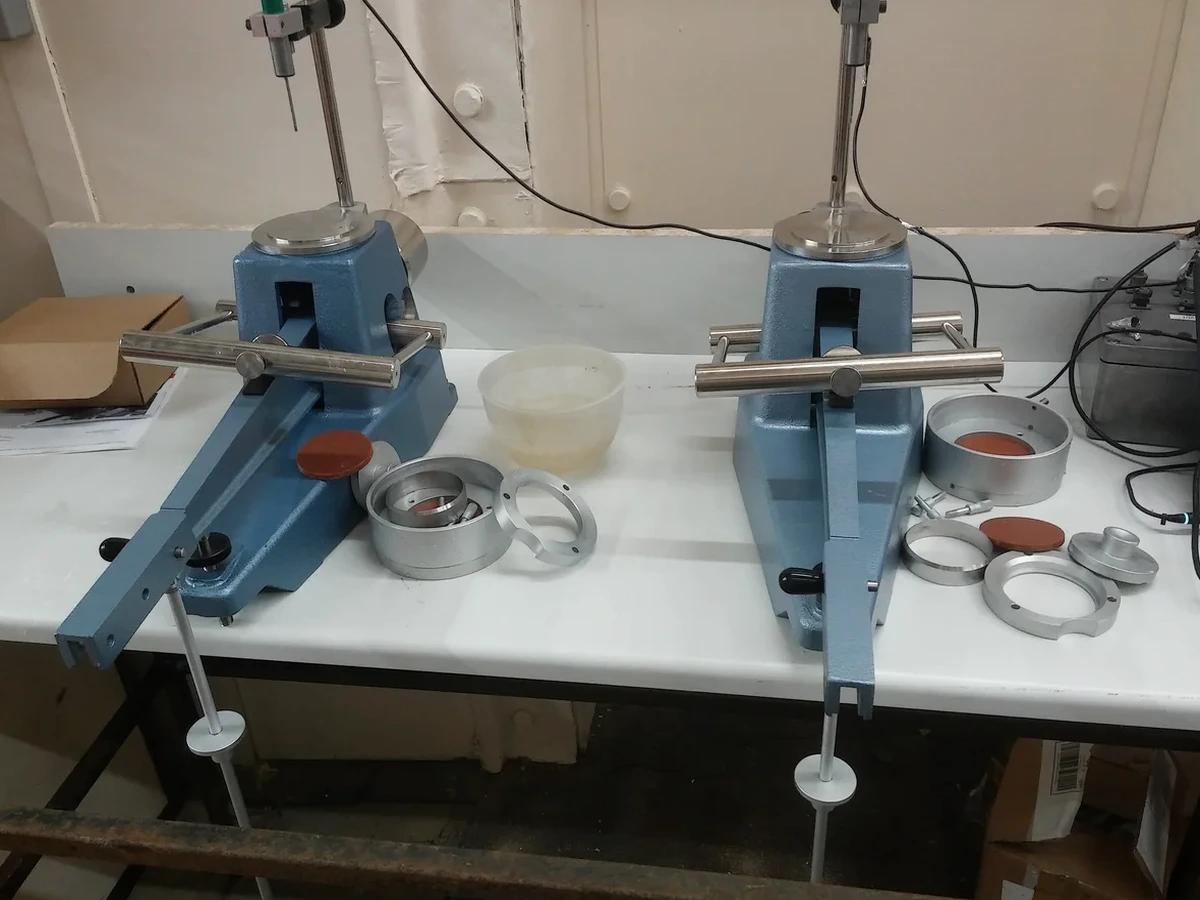
All laboratory testing conducted for projects in Bedford must comply with the rigorous standards set out in British Standards, notably BS 1377 for soils and BS EN ISO 17892 series for geotechnical investigation and testing. These norms dictate everything from sample preparation and test procedures to reporting formats and quality control, ensuring that results are reliable, repeatable, and legally defensible. For earthworks, the Specification for Highway Works (SHW) Series 600 is frequently invoked, requiring specific compliance testing for fill materials. Adherence to these standards is not merely best practice but a contractual and regulatory necessity, often mandated by planning authorities, the Environment Agency, and warranty providers such as NHBC.
A wide array of projects in the Bedford area depend on thorough laboratory testing. Residential developments on the urban fringe must characterise Oxford Clay to design robust foundations and appropriate soakaway drainage. Highway schemes, such as the A421 improvements or local link roads, require extensive compaction and California Bearing Ratio (CBR) testing to ensure pavement longevity. Commercial and industrial builds on the riverside gravels need careful assessment of granular materials through particle size distribution tests, while flood defence works along the Great Ouse rely on permeability and shear strength data. Even smaller-scale extensions and renovations benefit from basic classification suites to avoid unforeseen ground-related issues.
Available services
Quick answers
What is the typical turnaround time for geotechnical laboratory testing in Bedford?
Turnaround times vary by test type and workload. Basic classification tests like moisture content and plasticity index often take 3-5 working days, while consolidation or triaxial tests can require 1-3 weeks due to longer saturation and shearing stages. Urgent scheduling is usually available for critical project phases, but it is essential to discuss timelines with the laboratory during project planning to align with construction programmes.
Why is laboratory testing necessary when site investigation logs already describe the soil?
Field descriptions are qualitative and rely on visual and manual assessments, which cannot quantify engineering properties. Laboratory testing provides objective, numerical data on strength, compressibility, and chemical composition. This data is essential for analytical design models, validating ground models, and satisfying the requirements of Eurocode 7, which mandates a level of investigation commensurate with the geotechnical complexity and project risk.
How should soil samples be handled between the site and the laboratory to ensure valid test results?
Sample integrity is paramount. Disturbed samples for classification should be sealed in heavy-duty plastic bags. Undisturbed samples, such as U100 tubes or core samples, must be kept upright, protected from vibration, and stored in a cool, humid environment to prevent moisture loss. They should be transported to the laboratory as soon as possible, ideally within 24-48 hours, and accompanied by a chain of custody form detailing the sampling conditions.
What laboratory tests are specifically required for assessing sulphate attack risk in Bedford's Oxford Clay?
The Oxford Clay contains pyrite which oxidises to form sulphates, posing a chemical attack risk to buried concrete. The key tests are water-soluble and total potential sulphate content (to BRE Special Digest 1), along with pH determination. These results are used to classify the site into a Design Sulphate Class, which then dictates the appropriate concrete mix design and protective measures required to ensure durability under UK building regulations.