The geology along the River Great Ouse valley shapes everything we do in Bedford. Thick sequences of river gravels and loose alluvial sands dominate the subsurface, and while they drain well, their natural density often falls short of what modern foundations demand. We see this pattern constantly in samples pulled from boreholes near the Embankment and out toward the new developments south of the A421. When you combine loose granular deposits with a water table that sits just a couple of metres down, vibrocompaction becomes the logical ground improvement path. Our laboratory team pairs compaction design with a rigorous grain size analysis programme to confirm that the particle distribution will respond to vibratory energy before any rig mobilises to site.
Loose Ouse gravels compact beautifully with depth vibrators, but only when silt lenses are mapped and isolated before the rig arrives.
Methodology applied in Bedford
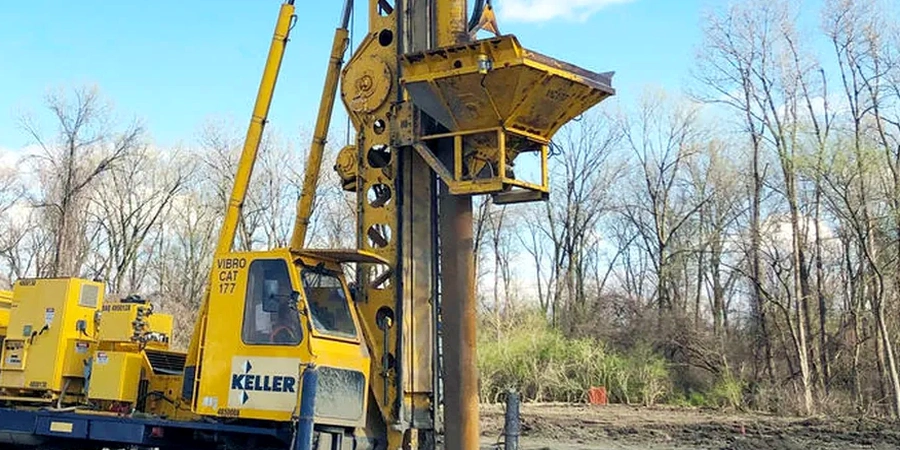
Risks and considerations in Bedford
One thing we keep running into on Bedford sites is the assumption that gravel equals uniform gravel. The Ouse deposits are far from uniform. They contain buried channels filled with organic silt and peat that compaction probes simply cannot treat. If you miss these during the site investigation, the design looks perfect on paper but delivers differential settlement in practice. We have seen cases where a vibrocompaction grid was laid out based on a desk study alone, and the rig hit soft organic material at 8 m that had zero granular response. The fix is always more expensive than the upfront investigation. We now insist on cone penetration testing at every probe location when the borehole log shows any hint of interbedded soft layers, and we pair the compaction specification with a stone columns contingency for zones where vibratory treatment alone will not reach the required stiffness.
Our services
Our Bedford ground improvement work is supported by a laboratory that runs the full suite of index and mechanical tests needed to confirm treatability before design begins.
Vibrocompaction design package
Complete design including grid geometry, probe energy profile, stage duration, and post-treatment verification plan. All to BS EN 14731:2005 with Execution Class 2 documentation.
Pre-treatment granulometric assessment
Sieve analysis to BS 1377-2:1990 and fines content determination to confirm that the soil falls within the treatable range for depth vibrators.
Quick answers
What soil types in Bedford respond best to vibrocompaction?
The sandy gravels and gravelly sands of the River Great Ouse floodplain are ideal. Fines content below 12 percent gives the best results. Silty and clayey layers do not compact under vibration and need a different treatment approach such as stone columns or rigid inclusions.
How is the design verified after compaction?
We specify pre- and post-treatment CPT or SPT at agreed grid locations. The acceptance criterion is typically a relative density of 70 percent or higher, confirmed by correlation from cone resistance. BS EN 14731 also requires a trial zone before full production to calibrate probe spacing and energy input.
What does vibrocompaction design cost for a typical Bedford site?
For a residential or light commercial plot in Bedford, a full design package including granulometric assessment, grid layout, and verification specification runs between £1,330 and £4,040 depending on the treated area and the number of verification locations required.
Can vibrocompaction be used close to existing structures in Bedford town centre?
It can, but with careful monitoring. Vibrations can affect adjacent buildings, so we set peak particle velocity limits based on BS 7385-2 and install monitoring points on nearby structures. In very sensitive environments we reduce probe energy and tighten the grid rather than risk damage to historic masonry.