Bedford’s geology is dominated by the Oxford Clay Formation and overlying Quaternary river terrace gravels, a sequence that demands careful compaction verification. When the Great Ouse deposited layers of alluvium and sands across the valley floor, it created a substrate where density can swing dramatically across a single site. The sand cone test provides a direct, site-based measurement of in-place density on these materials, giving engineers a reliable figure for compaction control without the assumptions that plague indirect methods. Because the technique physically excavates a sample and replaces the void with calibrated sand, the result reflects actual field conditions — critical when bearing layers lie above highly compressible clays. For earthworks pads near the Priory Marina or foundation subgrades in the Castle Road area, we combine sand cone readings with Proctor compaction to establish the relative compaction ratio against the laboratory maximum dry density, a benchmark required by the UK Specification for Highway Works Series 600.
On Oxford Clay sites where moisture content fluctuates seasonally, a sand cone test delivers a verifiable in-place density that cannot be derived from laboratory curves alone.
Methodology applied in Bedford
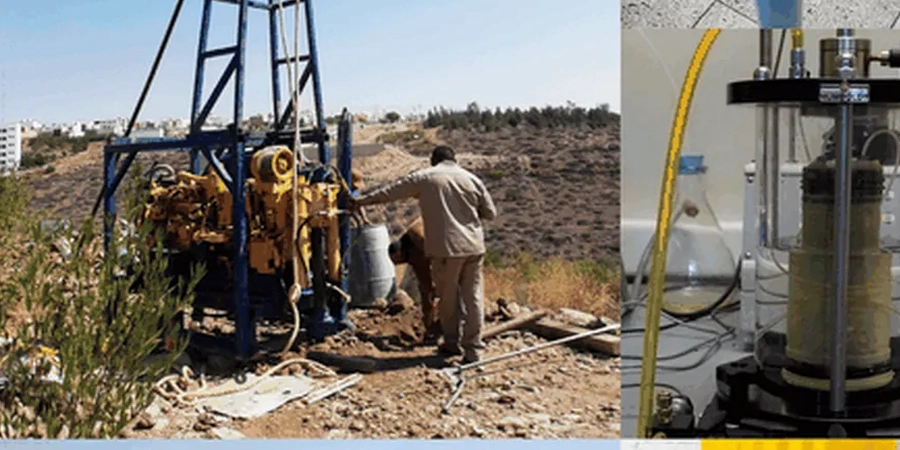
Risks and considerations in Bedford
The seasonal wetting-drying cycles on Bedford’s clay-rich soils create a compaction risk that is often underestimated at the design stage. During late autumn, when the Oxford Clay swells and the upper gravels become saturated, a fill compacted to specification in August can lose significant bearing capacity if its density was never verified in the field. We have reviewed earthworks near the Bedford River Valley Park where differential settlement appeared within two years, traced back to layers that passed visual inspection but fell below 95% relative compaction when tested post-construction. Pairing sand cone density checks with grain size analysis allows the engineer to confirm that the fill material itself matches the grading envelope assumed in the specification, ruling out fines migration as a contributing factor. Where the subgrade consists of low-plasticity silts, as found in pockets along the Elstow Brook corridor, the sand cone method remains the preferred technique because it does not rely on backscatter radiation that can misread density in soils with elevated organic content.
Our services
Our Bedford service covers the full cycle of compaction verification, from laboratory Proctor references through to field density testing and compliance reporting.
Sand Cone Field Density
On-site determination of in-place wet and dry density on compacted fills, subgrades, and trench backfill across Bedford borough, using calibrated sand to BS 1377-9.
Proctor Reference Testing
Standard and modified Proctor compaction tests in our UKAS-accredited laboratory to establish the maximum dry density and optimum moisture content for site materials.
Grading and Classification
Sieve and sedimentation analyses to confirm that fill material conforms to the specified grading envelope, supporting density results with particle-size data.
Compaction Compliance Reports
Technical reports mapping density results against lift thickness, moisture content, and specification thresholds, prepared for NHBC or local authority sign-off.
Quick answers
What is the typical cost of a sand cone field density test in Bedford?
For sites in and around Bedford, a single sand cone test generally falls within the range of £70 to £130, depending on access conditions and the number of tests requested on the same visit. Mobilisation costs reduce significantly when multiple points are tested in sequence, which is the standard approach for earthworks compaction control.
On what soil types does the sand cone method work reliably?
The sand cone method is suitable for soils with particle sizes up to medium gravel, roughly 20 mm, which covers the river terrace gravels and Oxford Clay-derived fills typical of the Bedford area. It should not be used on coarse, open-graded gravels where the sand would migrate into the voids, nor on very soft clays where the excavation walls collapse before the sand is poured.
How does BS 1377-9 relate to Eurocode 7 for field density testing?
BS 1377-9:1990 provides the procedural detail for the sand replacement method, while BS EN 1997-2:2007 (Eurocode 7, Part 2) sets the overarching requirements for ground investigation and field testing. In practice, UK earthworks specifications reference BS 1377 for the test method and Eurocode 7 for the design verification framework, so a compliant report must satisfy both documents.
How many tests are needed for a typical housing plot in Bedford?
The frequency of density tests follows the project specification, but a common benchmark from the UK Specification for Highway Works Series 600 is one test per 500 square metres per lift. On a residential plot in areas like Great Denham or Wixams, this often translates to between three and six tests per compacted layer, depending on the total footprint and the variability of the underlying ground.