The Great Ouse valley defines Bedford's subsurface, but anyone who has broken ground near the Embankment knows the soil profile shifts fast. Beneath a thin crust of topsoil, you hit soft alluvial silts and clays that extend down to the Oxford Clay Formation, with pockets of river terrace gravels sitting unpredictably along the old floodplain. Without a proper grain size analysis covering both the coarse and fine fractions, foundation drainage assumptions fail. A sieve stack handles the gravel and sand portion, but the silt and clay fraction requires hydrometer testing to separate what actually controls permeability and frost susceptibility. The town's mix of historic brickearth deposits and modern fluvial sediments means two boreholes fifty metres apart can return completely different grading curves, a reality that has caught out more than one developer working the riverside regeneration zones.
A complete grading curve from 75 mm down to 2 microns is the single most useful dataset for predicting how Bedford's riverine soils will drain, compact, and settle.
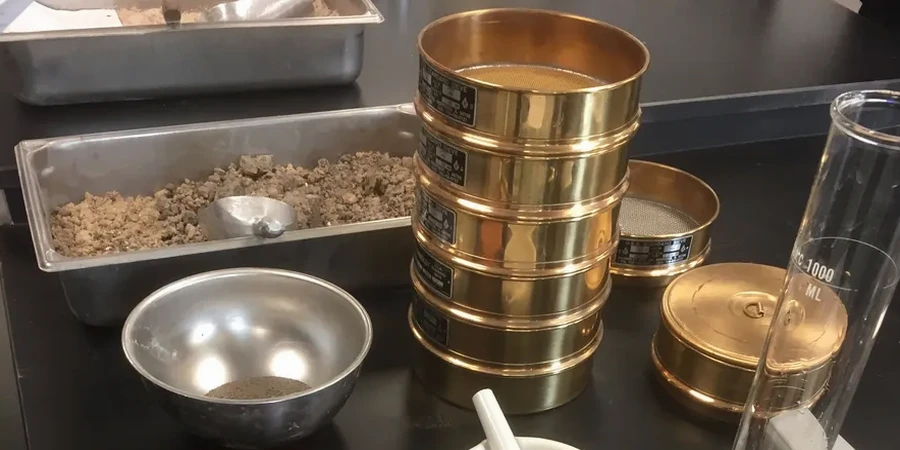
Methodology applied in Bedford
Risks and considerations in Bedford
A contractor on a Bedford school extension learned the hard way what skipping a full hydrometer analysis costs. The borehole logs described the material as sandy CLAY based on visual classification, so the soakaway design proceeded on that assumption. After the first wet winter, the playground flooded repeatedly. A subsequent grain size analysis revealed the soil was actually clayey SILT with a fines content of seventy-two percent and a D10 of less than one micron. The infiltration rate was two orders of magnitude below what the initial desk study had assumed. The retrofit involved excavating the entire drainage field, importing granular fill, and installing a pumped outfall to the surface water sewer, adding roughly forty thousand pounds to a project that could have been designed correctly from day one. On the floodplain sites south of the river, where the ground can alternate between free-draining gravel and near-impermeable alluvium within a single building footprint, the grading curve is not a paperwork exercise. It is the difference between a drainage scheme that works silently for decades and one that fails the first time the Great Ouse rises.
Our services
The particle size distribution feeds into multiple design workflows, so we have structured the reporting around what Bedford's consulting engineers actually need to specify. Each service below can be ordered standalone or bundled with the site investigation.
Combined Sieve and Hydrometer Analysis
The full grading curve from coarse gravel down to clay colloids, suitable for any soil encountered across Bedford's geological sequence. Delivered as a particle size distribution chart with tabulated passing percentages at standard sieve sizes plus hydrometer readings at 0.5, 1, 2, 5, 15, 30, 60, 120, 240, and 1440 minutes.
Sieve-Only Analysis (Coarse Fraction)
For free-draining river terrace gravels and sands where the fines content is visibly below five percent. Faster turnaround and lower cost, provided the engineer confirms that hydrometer data is not required for the design in question.
Hydrometer-Only Analysis (Fine Fraction)
Applied to samples where the material passes the 63-micron sieve almost entirely, such as the Oxford Clay and alluvial basin silts found across Bedford. Includes dispersant selection testing to confirm complete deflocculation of the clay fraction.
Particle Size Distribution with Permeability Correlation
A combined report that pairs the grading curve with Hazen and Kozeny-Carman permeability estimates, cross-referenced against in-situ falling-head tests where available. Particularly useful for soakaway and SuDS design on the clay-rich soils prevalent in Bedford.
Quick answers
How much sample material do you need for a full sieve and hydrometer test?
For a typical Bedford soil containing both sand and clay fractions, we need approximately 500 grams of material that has been oven-dried and gently disaggregated. If the sample is predominantly fine-grained Oxford Clay, 200 grams is sufficient. The sample must be representative of the stratum in question, so we recommend taking it from a disturbed bag sample collected during the borehole or trial pit investigation rather than scraping from the surface.
What does a grain size analysis cost for a project in Bedford?
A combined sieve and hydrometer analysis typically runs between £70 and £130 per sample, depending on the number of samples in the batch and whether you need the standard three-day turnaround or an express service. Sieve-only testing sits at the lower end of that range, while hydrometer analysis on highly plastic clays that require extended sedimentation periods falls at the upper end.
Is the hydrometer test really necessary, or can we just use the sieve data?
If your sample contains more than ten percent passing the 63-micron sieve, the hydrometer is essential. The sieve data alone tells you nothing about the silt and clay distribution, and in Bedford's alluvial soils the difference between a silty clay and a clayey silt completely changes the permeability, frost heave susceptibility, and compaction behaviour. Skipping the hydrometer on a fine-grained soil is like reading only half the structural drawings before pouring concrete.
How soon can I get the results back from the lab?
Our standard reporting turnaround is three working days from sample receipt at the laboratory. The hydrometer sedimentation process itself runs for a minimum of twenty-four hours to capture the full fine-fraction settling curve. Express service with overnight readings and same-day reporting is available for time-critical projects, though we advise clients that the extended sedimentation period produces more reliable data for the sub-2-micron fraction.