Bedford’s expansion from a medieval market town on the River Great Ouse into a modern logistics hub has pushed infrastructure demands hard across the borough. The Marston Vale and western growth areas sit on Oxford Clay formations and river terrace gravels that vary from dense granular layers to highly plastic, moisture-sensitive clays. When those clays get wet during a typical Bedford winter, CBR values can drop below 2% on the natural subgrade unless you’ve got the lab data to design for it. That’s exactly why our laboratory CBR test programme exists—not just to tick a specification box, but to give you a soaked and unsoaked strength profile you can trust when the asphalt goes down. For clients pushing large earthworks near the A421 corridor, we often pair the CBR data with a field CBR assessment to validate lab-to-field correlation before placing capping layers.
A soaked CBR of 2% versus 5% in Bedford’s Oxford Clay can change your capping thickness by over 250mm—that’s a cost decision driven entirely by lab data.
Methodology applied in Bedford
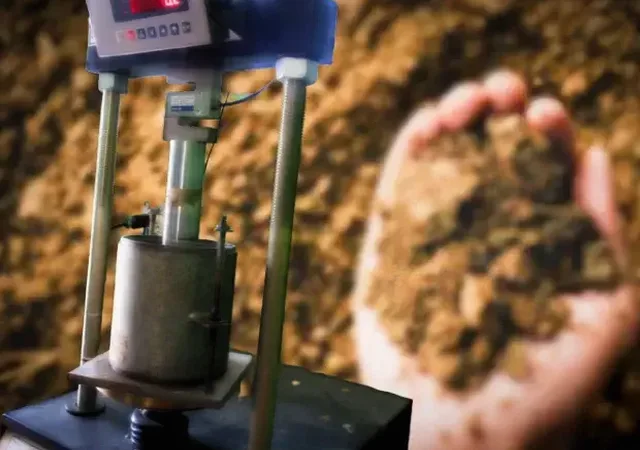
- Three-point compaction effort to establish the full moisture-density-CBR envelope
- Surcharge weight simulation matching the final pavement construction depth
- Soaked and unsoaked penetration curves plotted on the same axis for direct comparison
- Swelling measurement during the soak phase, recorded every 24 hours
- Rapid reporting: standard results within 48 hours of sample receipt
Risks and considerations in Bedford
The geology along the Great Ouse floodplain creates a testing challenge that catches out teams unfamiliar with Bedford’s ground. The Oxford Clay here contains thin silt partings that act as drainage paths during the soak phase, accelerating saturation and producing CBR values lower than what the bulk clay mineralogy would suggest. Combine that with the seasonal groundwater rise—often peaking between January and March—and a subgrade that looked competent in August can lose 60% of its bearing capacity by February. Running the laboratory CBR test only at optimum moisture without a soak cycle misses this entirely. Specification writers working to Series 600 of the Manual of Contract Documents for Highway Works should insist on soaked CBR values for all cohesive subgrades in the Ouse catchment. The extra four days of testing is cheap insurance against a pavement failure that costs six figures to remediate.
Our services
Our Bedford laboratory CBR testing is incorporated within a comprehensive geotechnical programme. The following services are commonly integrated with CBR work on local projects:
Moisture Condition Value (MCV)
Rapid assessment of earthworks acceptability under BS 1377-4, ideal for tracking compaction quality alongside CBR on large Bedford infrastructure sites.
Plasticity Index and Atterberg Limits
Classification testing that predicts volume change potential in the Oxford Clay—essential context for interpreting soaked CBR results.
Particle Size Distribution
Wet sieving and sedimentation to BS 1377-2, determining the sand, silt, and clay fractions that govern drainage behaviour during the soak period.
Compaction (Proctor) Testing
Establishing the maximum dry density and optimum moisture content for the material you are testing, so CBR specimens are prepared at the specification target.
Quick answers
How much does a laboratory CBR test cost in Bedford?
A single-point laboratory CBR test to BS 1377-4 typically costs between £110 and £140, depending on whether you need just the soaked value or a full three-point family with compaction curves. Volume pricing applies for projects requiring ten or more determinations.
Why does my specification demand a 96-hour soak instead of a quicker test?
The four-day soak simulates long-term saturation conditions that a subgrade will experience over its service life. For low-permeability clays like the Oxford Clay found across Bedford, shorter soak periods consistently overestimate the in-service CBR, leading to under-designed pavements.
Can you test site-won material or only imported aggregates?
Both. The laboratory CBR test is routinely run on natural subgrade samples, site-won chalk or clay, and imported capping or sub-base materials. For Bedford projects reusing excavated Oxford Clay as engineered fill, we recommend testing at both natural moisture content and after a wetting-up sequence.