The triaxial cell is already primed when the sample from Bedford arrives at the lab. A cylindrical specimen trimmed from a Shelby tube sits inside the transparent chamber, confining pressure applied by de-aired water. The loading frame above it will push at a controlled strain rate while transducers measure deviator stress and pore pressure. That is the core of a soil mechanics study for Bedford’s geology: direct measurement of effective stress parameters, not correlations. Before the cell even reaches failure, the consolidation phase has already told us about the Oxford Clay or glacial till compressibility. The load ring, the back-pressure system, and the volume-change gauge work together on a bench that runs BS 1377-8 procedures daily. For projects needing complementary in-situ data, the SPT drilling programme provides N-values that correlate with the lab-derived friction angle, giving the design team a complete picture of the ground.
Effective stress parameters from triaxial testing on Bedford Oxford Clay typically show c' of 0-5 kPa and φ' between 22° and 28°, depending on the weathering grade.
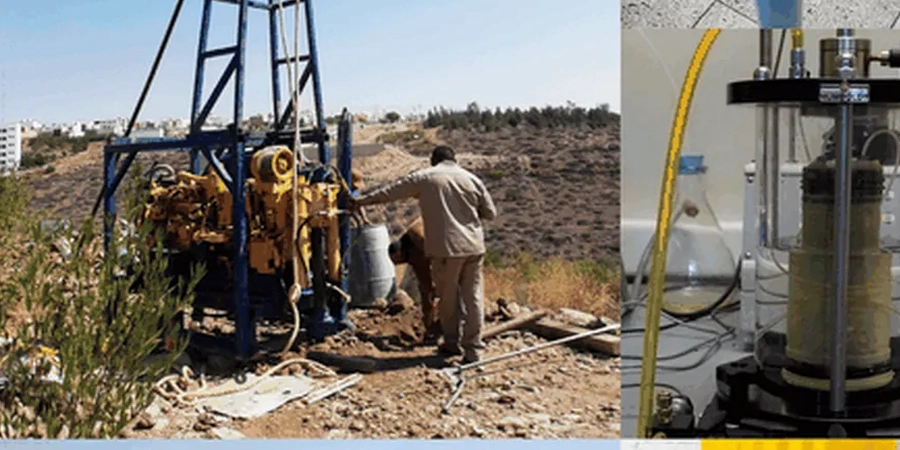
Methodology applied in Bedford
Risks and considerations in Bedford
Bedford sits on a geological boundary where the permeable river gravels of the Great Ouse meet the low-permeability Oxford Clay, creating a perched water table that fluctuates seasonally by over a metre. This hydrogeological contrast means that a soil mechanics study that ignores effective stress analysis is gambling with bearing capacity. During wet winters, pore pressures rise in the granular layers and reduce the effective stress at the gravel-clay interface, which is exactly where many shallow foundations bear. The lab has seen samples from the Castle Road area where sulphate levels in the Oxford Clay exceed BRE Special Digest 1 Class DS-3 thresholds, requiring sulphate-resisting cement in any buried concrete. Shrink-swell potential is another variable, with the clay’s high plasticity index driving volume changes that can lift lightly-loaded footings during prolonged dry spells, a mechanism familiar to structural engineers working on Bedford’s Victorian terraces.
Our services
The soil mechanics study we deliver for Bedford projects covers the full chain from sample extrusion to the geotechnical interpretative report. Everything happens on the same bench so the technician sees the sample from its arrival to the final data sheet.
Classification and Index Testing
Moisture content, Atterberg limits, particle density, and particle size distribution by wet sieving and hydrometer, all run to BS 1377-2 on samples from cable percussion boreholes across Bedford.
Strength and Deformation Testing
Triaxial compression (CU and CD), direct shear on granular materials, and unconfined compression for stiff clays. Oedometer consolidation tests to derive mv, cv, and Cc for settlement calculations.
Chemical and Durability Analysis
Sulphate content, pH, and organic matter determination to BRE SD1 and BS 1377-3 standards, critical for concrete specification in the Oxford Clay formation underlying Bedford.
Quick answers
What does a soil mechanics study for a Bedford site typically cost?
For a residential or small commercial project in Bedford, a comprehensive laboratory soil mechanics study usually falls between £2,810 and £4,720, depending on the number of samples and the test suite required. A basic package might include classification, shear box, and oedometer tests, while a full programme with triaxial and chemical analysis sits at the upper end. The investment ensures the foundation design matches the actual ground conditions rather than conservative assumptions.
Which parameters from the study matter most for foundation design in Bedford?
The undrained shear strength (cu) governs short-term bearing capacity on the Oxford Clay, while effective stress parameters c' and φ' control long-term stability. Consolidation parameters Cc and cv are equally important because they determine how much and how fast a foundation will settle under load. For sites near the river, permeability from oedometer or triaxial tests feeds directly into dewatering and drainage design.
How long does the laboratory testing phase take for a Bedford project?
Classification tests can be turned around in 5 to 7 working days. Triaxial and oedometer tests take longer because of the consolidation and shearing stages — typically 3 to 4 weeks for a full suite on multiple samples. The schedule depends on the clay’s permeability: Bedford’s Oxford Clay consolidates slowly, so the oedometer stage alone can run for 10 days per specimen to reach the end of primary consolidation.