High-damping rubber bearings and flat sliding pendulums arrive on-site in Bedford inside reinforced timber crates, each unit tagged with a shear modulus batch number and a factory test certificate. Before the first isolator is positioned on the plinth, the substructure must transmit loads into the stiff Oxford Clay Formation that underlies much of the borough — a Jurassic overconsolidated clay with undrained shear strengths frequently exceeding 100 kPa across the Great Ouse valley. The design sequence starts with a site-specific response spectrum, not a generic type curve. Seismic hazard for Bedford, approximately 120 km from the nearest plate boundary, is governed by intraplate events with return periods of 475 and 2,475 years as defined in the UK National Annex to BS EN 1998-1:2004. Ground motion is modest — peak ground acceleration on rock rarely surpasses 0.04g for the 475-year event — but the deep clay basin can amplify long-period energy precisely in the range where base isolation is most effective. The isolator period, typically 2.5 to 3.5 seconds for a mid-rise frame, is tuned so that spectral acceleration falls below the superstructure’s elastic capacity, converting seismic demand into a displacement problem managed by the bearing’s lateral clearance. Complementary ground investigation with seismic microzonation refines the bedrock depth profile and shear-wave velocity contrasts that control basin-edge effects across the town.
In low-seismicity regions like the UK, base isolation is not about surviving extreme shaking — it is about eliminating downtime by keeping the superstructure elastic.
Methodology applied in Bedford
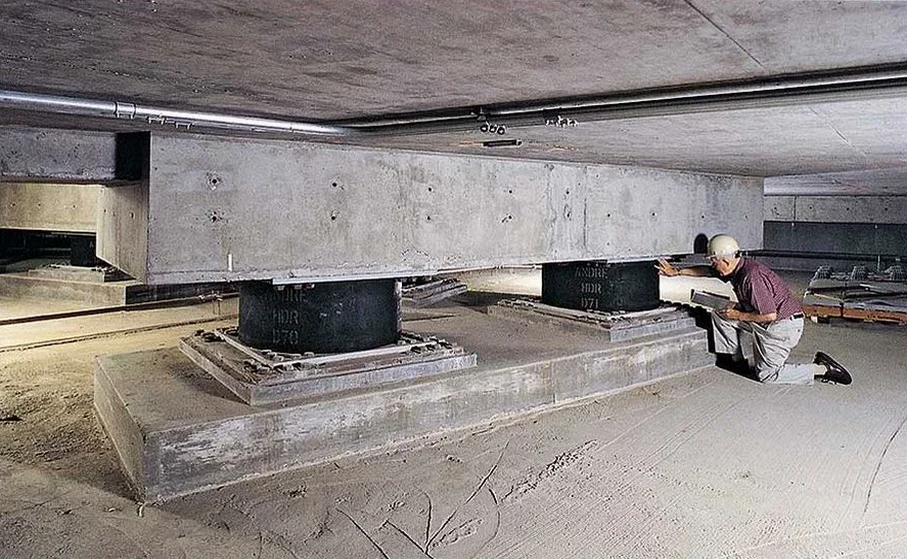
Field demonstration
Risks and considerations in Bedford
Bedford’s seismic hazard is not defined by large magnitude events but by moderate shaking at long return periods combined with a soil basin that traps and amplifies energy. The Oxford Clay, though stiff, is up to 70 metres thick beneath the town centre, and its impedance contrast with the underlying Cornbrash limestone creates a waveguide that can increase spectral ordinates at periods above 1.0 second by a factor of two or more relative to rock outcrop. For a conventionally fixed-base structure, this amplification is manageable because the structural period is short. For a base-isolated structure with a target period of 3.0 seconds, however, the amplified basin response falls directly within the displacement-sensitive region of the spectrum, increasing isolator stroke and demanding larger moat clearances. The second risk is low-temperature crystallisation of the elastomer: Bedford’s winter lows can reach -8 °C, and HDRB compounds must pass the shear modulus stability test at -20 °C per Annex D of BS EN 15129. A non-compliant compound will stiffen, shorten the isolation period, and pull the structure back toward the spectral acceleration peak — effectively cancelling the isolation benefit on the coldest days.
Our services
The application of base isolation in a UK context demands a tight integration between seismological input, geotechnical characterisation, and structural modelling. The services below cover the full design chain from hazard definition to bearing prototype testing, always referenced to the Bedford ground profile.
Site-specific seismic hazard and ground response analysis
Definition of the elastic response spectrum for rock and soil sites in Bedford using the BGS stochastic hazard model and site response amplification factors. The output includes acceleration time histories spectrally matched to the uniform hazard spectrum at periods of 0.01 to 4.0 seconds, formatted for direct input into nonlinear time-history analysis in ETABS or SAP2000.
Isolation system design and prototype testing specification
Selection of isolator type — HDRB, lead-rubber, or curved surface slider — based on superstructure period, column loads, and displacement demand. The deliverable includes bearing schedules with shear modulus, shape factor, and damping ratio for each support line, plus a factory production control plan aligned with BS EN 15129 Annex B and prototype test programme requirements.
Quick answers
Is base isolation viable for low-rise residential buildings in Bedford given the UK's low seismicity?
Technically yes, but the economic case depends on the building's value and occupancy. For a standard two-storey masonry house, the isolator cost and the moat wall construction typically outweigh the seismic risk reduction because the 475-year PGA in Bedford is below 0.04g. Base isolation becomes viable for high-value residential blocks, listed structures, or buildings where post-earthquake functionality is non-negotiable — for example, a care home or a data centre. The isolator displacement demand in Bedford is modest (under 100 mm for short-period structures), which keeps the moat detail simple and the cost increment manageable.
What is the typical cost range for a base isolation design package for a Bedford project?
A complete design package — covering seismic hazard definition, isolator selection, nonlinear time-history analysis, and a prototype test specification — for a mid-rise structure in the Bedford area generally falls between £3,100 and £6,550, depending on the number of bearing types and the complexity of the ground response modelling. This excludes the isolator manufacture and testing costs, which are procured separately from the bearing supplier.
How is the Oxford Clay's dynamic stiffness incorporated into the isolation design?
We measure the small-strain shear modulus (Gmax) from seismic cone penetration tests or cross-hole surveys conducted on the Bedford site, then apply modulus reduction and damping curves — typically Darendeli (2001) or Vucetic-Dobry — to degrade the stiffness to the strain level expected under the design earthquake. The resulting Vs profile feeds a one-dimensional equivalent-linear site response analysis (using DEEPSOIL or STRATA) that generates the free-field surface spectrum for which the isolators are designed. For deep clay basins like the Great Ouse valley, a two-dimensional basin model may be warranted if the basin width-to-depth ratio suggests lateral resonance effects.