Bedford sits on a varied geological palette that keeps every ground investigation interesting. The River Great Ouse has carved a broad floodplain through the town centre, laying down soft alluvium and river terrace gravels over the Oxford Clay formation. This clay can be surprisingly stiff in places, but its behaviour under load is not something you want to guess at. Over in the Brickhill and Putnoe areas, glacial tills add another layer of complexity to the soil profile. When a project in Bedford pushes beyond standard bearing capacity checks, the triaxial test becomes the reference point for understanding how the ground will actually behave. In our experience, a well-executed consolidated-undrained or drained test changes the conversation from assumption to evidence, particularly where deep excavations or embankments are planned near the river corridor. For projects on the northern fringes where made ground is common, it pays to combine the triaxial test with a thorough test pit investigation to verify the fill composition before selecting shear strength parameters.
A single consolidated-undrained triaxial test on Oxford Clay often reveals a cohesion intercept that standard correlations would overestimate by 30 to 40 percent.
Methodology applied in Bedford
Risks and considerations in Bedford
Bedford's expansion since the 1960s pushed residential development onto the surrounding clay slopes and into former brickpit areas that had been backfilled with uncontrolled material. The legacy of this growth pattern is a patchwork of ground conditions where a uniform design approach simply does not work. The most common problem we encounter is differential settlement between structures founded on natural clay and those partially bearing on thicker lenses of river gravel or pockets of softer alluvium. A triaxial test programme that captures the stiffness contrast between these materials gives the design team the numbers needed to justify ground improvement or a switch to piled foundations. There is also a hydraulic risk specific to Bedford: the Ouse's winter levels can sustain a high phreatic surface for weeks, reducing effective stress beneath foundations and softening the clay at shallow depth. The drained strength parameters from a triaxial test become essential for assessing this long-term condition, because the short-term undrained strength can give a misleading picture of stability during the design life of the structure.
Our services
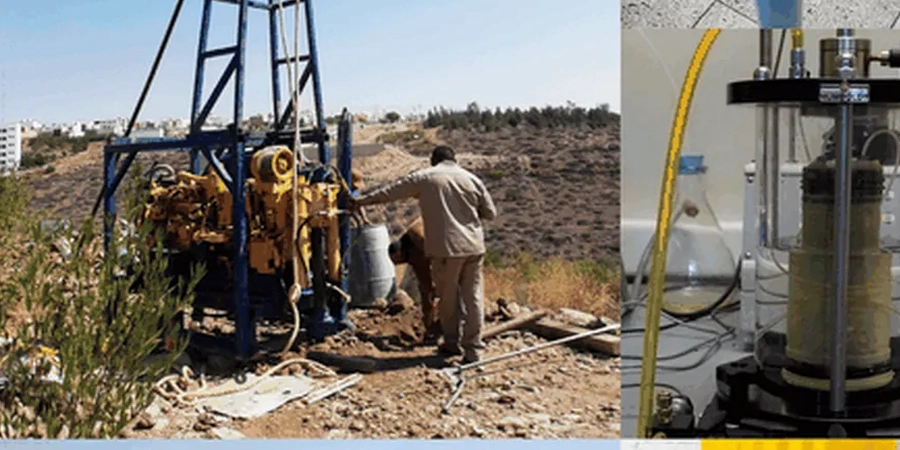
Our triaxial testing capability in Bedford covers the full range of shear strength and stiffness measurement needed for geotechnical design. Samples are collected by local drilling crews and tested at our UKAS-accredited laboratory, with reporting structured to integrate directly into Eurocode 7 design packages.
Consolidated-Undrained (CIU) Triaxial Testing
The workhorse test for Bedford's clays. We consolidate the specimen to the estimated in-situ stress, then shear undrained while recording pore pressure at the mid-height. This delivers effective stress parameters (c' and φ') that hold for long-term stability analysis of embankments, cuttings, and retaining structures along the Ouse corridor.
Unconsolidated-Undrained (UU) Triaxial Testing
Used for short-term undrained strength in fully saturated clay. The UU test is practical when construction loading rates are fast relative to the clay's permeability, such as during excavation support design for basement construction in Bedford's town centre redevelopment zones.
Multi-Stage Triaxial Testing
When sample recovery from a borehole is limited to a single good-quality tube, we run a multi-stage test on one specimen. The cell pressure is increased incrementally after each shear stage, producing a full failure envelope from one sample. This approach is particularly useful in the variable ground conditions found across Bedford, where losing a sample to a single test can delay the entire ground model.
Quick answers
How much does a triaxial test cost for a project in Bedford?
A standard triaxial test programme in Bedford typically ranges between £1,530 and £1,930, depending on the number of specimens, the test type (UU, CIU, or multi-stage), and how many confining pressures are required to define the failure envelope. The final figure includes sample transport from the Bedford site to the laboratory, specimen preparation, testing, and the interpretive report with Mohr-Coulomb parameters.
When is a triaxial test necessary instead of a simple shear vane or pocket penetrometer?
A triaxial test becomes necessary when the design requires accurate effective stress parameters for deformation or long-term stability analysis. Simple index tests like the shear vane give undrained strength at a point, but they cannot separate cohesion from friction or predict how the soil will behave as pore pressures change over time. In Bedford, where groundwater levels in the Ouse floodplain vary seasonally, the effective stress path from a triaxial test is far more informative for permanent works design.
What sample quality is needed for a reliable triaxial test?
Undisturbed samples are essential. We typically use Shelby tube samples taken in accordance with BS EN ISO 22475-1. The tubes must be sealed immediately on extraction, transported vertically, and kept at a stable temperature to avoid moisture loss. Any sample showing signs of disturbance during extrusion—cracks, softening, gravel partings—should be rejected or flagged in the report, because disturbance reduces measured stiffness and strength, sometimes significantly.
How long does a triaxial test programme take from sampling to report delivery in Bedford?
A standard CIU programme with three specimens usually takes 10 to 14 working days from sample arrival at the laboratory. The consolidation phase alone can take 24 to 48 hours per specimen for low-permeability Oxford Clay. We coordinate sample collection with our local drilling crew in Bedford so that the samples are delivered to the lab within the same working day, minimising the time between extraction and testing.
Which triaxial test type is most appropriate for Oxford Clay in Bedford?
In most cases, a consolidated-undrained test with pore pressure measurement (CIU) is the right choice. The Oxford Clay has a low hydraulic conductivity, so construction loading is effectively undrained in the short term, but the long-term condition is drained. The CIU test provides both the undrained strength and the effective stress parameters (c' and φ') from one programme. For very soft alluvium near the river, we sometimes add an unconsolidated-undrained test to bracket the short-term strength during the construction phase.