Bedford sits on the great Jurassic clay belt that stretches across middle England, with most of the town underlain by the Oxford Clay Formation at shallow depth. Over 80,000 people live above this stiff, fissured clay, which swells when wet and shrinks when dry—a ground condition that directly shapes every foundation decision in the borough. In our laboratory, we routinely see borehole logs from sites along the Great Ouse valley where clay consistency varies from firm to stiff within a single metre, something BS EN 1997-1:2004 addresses through the Observational Method. Designing a shallow foundation here means reconciling the allowable bearing pressure of the natural clay with the seasonal volume changes that can tear a rigid structure apart. We complement the desk study and ground investigation with test pits on accessible sites to log the weathered zone, and for larger commercial plots near the A421 corridor we often recommend CPT testing to get a continuous profile of undrained shear strength without disturbing the fabric of the clay.
Oxford Clay in Bedford can swell or shrink enough to lift a corner of a building by 40 mm between summer and winter—foundation depth is not a detail, it is the primary defence.
Methodology applied in Bedford
Risks and considerations in Bedford
The Great Ouse floodplain cuts through the centre of Bedford, and the alluvial deposits that line the river corridor are the single biggest source of shallow foundation problems in the town. These soft silty clays and peaty lenses can have undrained shear strengths below 30 kPa, meaning a standard strip footing that works perfectly on the Oxford Clay plateau will undergo excessive settlement or even a bearing failure if placed on the same geometry near the river. We have seen differential settlements of over 50 mm between two ends of a terrace house built on a transition zone—one half on stiff clay, the other on alluvium—and the cracking pattern that results is unmistakable. Vegetation adds a second layer of risk: mature oak and poplar trees extract moisture from depths well below 2 metres, and the NHBC Standards require foundation depths of up to 2.4 metres in the zone of influence. Ignoring a row of Lombardy poplars on the boundary has cost more than one Bedford developer a underpinning bill that exceeded the original foundation cost.
Our services
Our shallow foundation design work in Bedford covers the full chain from ground investigation specification through to final bearing capacity and settlement calculations. We work directly with structural engineers and architects to ensure the foundation solution fits the ground reality, not just the assumptions on a drawing.
Strip and Pad Footing Design on Shrinkable Clay
We calculate the required width and depth for strip and pad foundations on the Oxford Clay using the undrained shear strength from laboratory triaxial or in-situ SPT data, applying the bearing resistance equations from Annex D of BS EN 1997-1. Every design includes a serviceability check for total and differential settlement, and we specify the necessary clayboard, compressible fill, or deepened trench details where trees or hedgerows influence the soil moisture regime.
Raft Foundation Analysis and Ground Improvement Integration
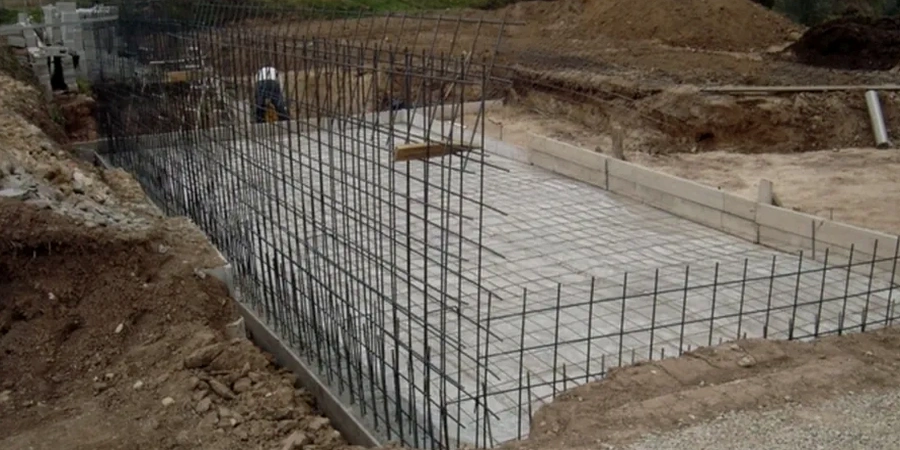
On soft alluvial soils near the Great Ouse or on made ground sites in the town centre, a reinforced concrete raft often becomes the most economical solution. We model the raft-soil interaction using modulus of subgrade reaction values derived from plate load tests or back-calculated from CPT data, and we design the granular compaction layer beneath the raft to bridge any soft spots. Where the bearing capacity is borderline, we specify stone columns beneath the raft footprint to transfer load to the stiffer clay below the alluvium.
Quick answers
What is the typical minimum foundation depth for a house extension in Bedford on Oxford Clay?
For a conventional two-storey extension with strip foundations on stiff Oxford Clay, we normally specify a minimum depth of 1.0 metre below ground level, but this increases to 1.5 metres or more if there are trees within influencing distance. The exact depth depends on the plasticity index of the clay, the proximity and species of any trees, and the presence of roots in the trial pit. We follow the NHBC Chapter 4.2 tables and calculate the required depth based on the specific site conditions.
How much does a shallow foundation design for a residential project in Bedford cost?
For a typical residential project—a house extension or a single new build—the shallow foundation design package, including bearing capacity and settlement calculations and a foundation schedule, usually falls between £1,370 and £2,750, depending on the complexity of the ground conditions and the number of foundation elements. If the site investigation data is already available from a previous phase, the cost tends toward the lower end of that range.
Can you design shallow foundations on the floodplain soils near the Great Ouse?
Yes, but the approach changes significantly compared to the Oxford Clay plateau. The alluvial silts and peats near the river have low bearing capacity and high compressibility, so we often move from strip footings to a reinforced concrete raft, sometimes with a granular improvement layer beneath. We run consolidated-undrained triaxial tests on undisturbed samples of the alluvium to get reliable strength parameters, and we check both short-term and long-term settlement under the design load.
What laboratory tests do you need to design a shallow foundation in the Bedford area?
At a minimum, we need moisture content, Atterberg limits, and undrained triaxial compression tests on undisturbed samples from the foundation depth. If granular layers are present, we add particle size distribution by sieving. For sites with trees, we also run soil suction profiles or oedometer swelling tests to quantify the heave potential. The exact suite depends on what the borehole logs reveal, and we always specify the testing programme after reviewing the ground investigation data.