Much of Bedford sits on the Oxford Clay Formation, a Jurassic marine deposit that can be heavily overconsolidated but becomes weathered and plastic near the surface. The River Great Ouse floodplain adds layers of soft alluvium with variable silt and clay content. Understanding the liquid limit and plastic limit of these soils is not a formality. It directly controls foundation depth, earthworks specification, and long-term serviceability. Our laboratory in Bedford runs Atterberg limits testing under BS 1377-2:1990 to give engineers the classification data they need before specifying a footing design or a retaining structure.
Plasticity index is still the single most useful number for predicting shrink-swell behaviour in the Oxford Clay beneath Bedford.
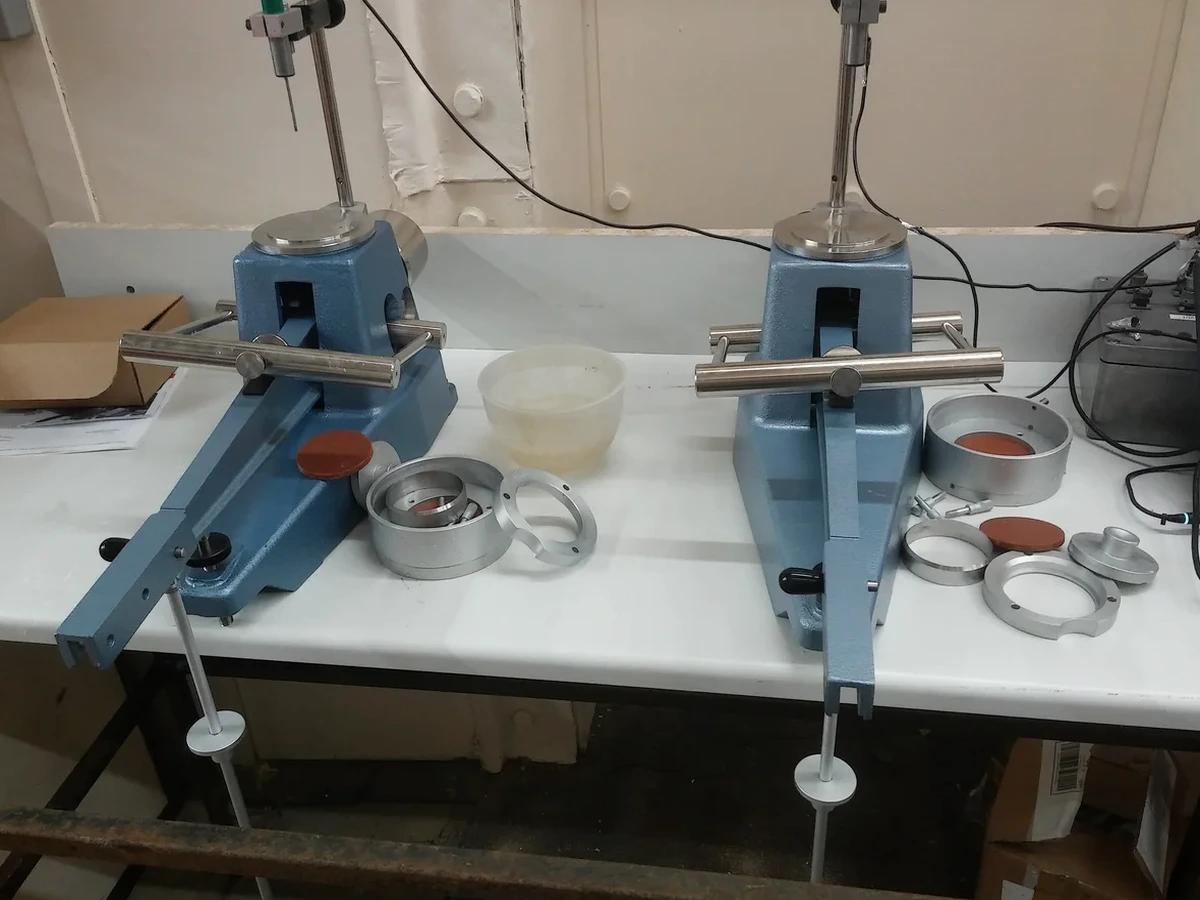
Methodology applied in Bedford
Risks and considerations in Bedford
Bedford's Victorian and Edwardian expansion often placed light brick foundations directly onto weathered Oxford Clay without any deep geotechnical investigation. That clay, when wetted by a leaking drain or a changed water table, swells. When it dries in a prolonged summer, it shrinks. The result is differential movement and cracking that insurance claims adjusters know all too well. A plasticity index above 20% means a soil is highly expansive. For a rear extension or a new build on an infill plot in the Castle Road area, skipping Atterberg limits is a direct risk to the structure and to the budget. The data feeds directly into the NHBC Chapter 4.2 requirements for volume change potential, letting the design team specify the correct foundation depth or suspended floor system before construction starts.
Our services
We handle Atterberg limits as part of a wider soil classification package. The test itself is simple in principle but requires a practiced technician to get repeatable, defensible numbers. Here is what we deliver on every Bedford project.
Liquid Limit and Plastic Limit (LL/PL)
Full Atterberg limits on disturbed samples from boreholes or trial pits. Includes four-point liquid limit determination, plastic limit by thread rolling, and calculation of plasticity index. Report includes flow curve plot and classification to BS 5930.
Shrinkage Limit and Linear Shrinkage
Additional determination of shrinkage limit using the mercury displacement or wax immersion method. Useful for highly plastic clays where volume change potential needs to be quantified for foundation design in accordance with NHBC guidance.
Quick answers
What is the typical turnaround time for Atterberg limits testing in Bedford?
Standard turnaround is three to five working days from sample receipt. For time-sensitive projects, we can expedite results within 48 hours. The limiting factor is the drying and soaking preparation, which cannot be rushed without compromising accuracy.
How much does Atterberg limits testing cost for a Bedford project?
A single-point determination of liquid limit and plastic limit typically falls between £50 and £80 per sample, depending on the number of samples in the batch and whether it is part of a larger classification suite.
What sample quantity do you need for the test?
We need approximately 500 grams of disturbed soil, sieved or broken down to pass a 425 µm sieve. The material should be in a sealed plastic bag to retain its natural moisture content. Samples can be delivered to our Bedford laboratory directly from your site.
Can you classify the soil type from Atterberg limits results?
Yes. The liquid limit and plasticity index are plotted on the Casagrande plasticity chart, which gives the soil classification according to the Unified Soil Classification System (USCS) and BS 5930. This tells you whether the material is a low-plasticity clay, a high-plasticity silt, or an organic soil.
Why are Atterberg limits important for foundations in Bedford?
Bedford sits largely on the Oxford Clay, which is known for its shrink-swell potential. The plasticity index from Atterberg testing directly indicates how much the soil will expand and contract with moisture changes. NHBC Standards use this value to specify minimum foundation depths near trees and to assess volume change potential.