Bedford sits squarely on the Peterborough Member of the Oxford Clay Formation: a stiff, overconsolidated clay that turns slick and remoulded the moment water gets into an excavation. We see it every week in the lab. Samples arrive from sites along the A421 corridor or beneath the embankments of the River Great Ouse, and the challenge is always the same — the undrained shear strength looks adequate on paper until you factor in the natural fissures and thin silt partings that control stand-up time in a tunnel face. A triaxial consolidated-undrained test with pore pressure measurement gives the effective stress parameters that an elastic-perfectly plastic model actually needs, and we run them at confining pressures matched to the crown, axis, and invert depths of the proposed alignment.
Fissured Oxford Clay fails along pre-existing discontinuities, not through intact material — effective stress triaxial testing captures the real strength envelope.
Methodology applied in Bedford
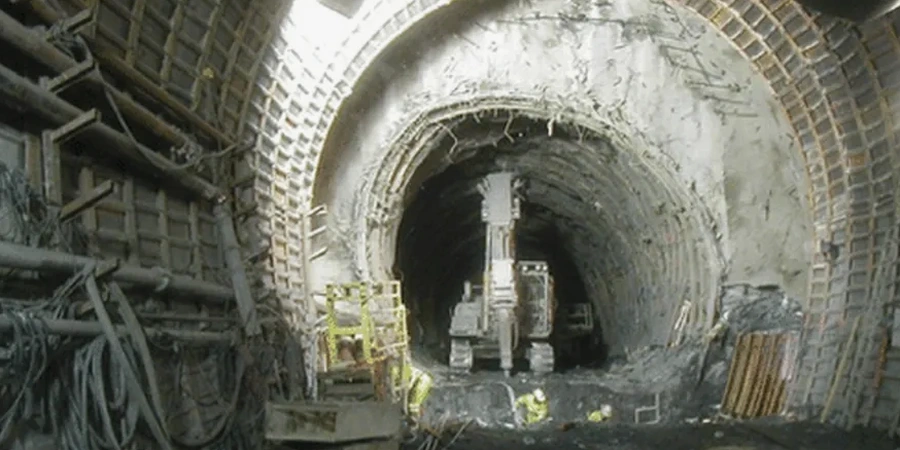
Field demonstration
Risks and considerations in Bedford
The geology under Bedford changes fast. Within a few hundred metres you can transition from weathered Oxford Clay into water-bearing river terrace gravels that require a completely different face support philosophy. The town centre and riverside redevelopments sit directly above these gravel lenses, and a tunnel drive that starts in competent clay can hit a gravel pocket with hydraulic connection to the Great Ouse. Dewatering is rarely an option in that scenario — the Environment Agency permits are restrictive — so the TBM needs to operate in a closed mode with a conditioned spoil that won't clog the screw conveyor. We characterise the Atterberg limits and fall-cone strength of the clay to design the conditioning dosage, and we test the gravel fraction for abrasivity using the Cerchar index so the cutterhead maintenance schedule matches the actual ground.
Our services
The laboratory programme for a Bedford tunnel project typically includes the following.
Triaxial and shear strength testing
Consolidated-undrained triaxial tests with pore pressure measurement at confining stresses matching the tunnel depth. We also run multistage direct shear on fissured specimens to define the post-peak strength envelope for numerical modelling.
Soil conditioning and spoil assessment
Atterberg limits, fall-cone tests, and slump tests on conditioned Oxford Clay to optimise foam and polymer dosage. Abrasivity testing (Cerchar and LCPC) on granular lenses for cutterhead wear prediction.
Quick answers
How much does a soft ground tunnel testing programme cost for a project in Bedford?
A full laboratory testing suite for a tunnel alignment in the Oxford Clay — including classification tests, triaxial CIU, direct shear, oedometer swell, and abrasivity — typically falls between £3.370 and £12.040, depending on the number of borehole samples, the testing frequency per linear metre, and whether multistage shear or advanced stress path triaxials are required.
What makes the Oxford Clay in Bedford challenging for tunnelling?
The Oxford Clay in Bedford is heavily fissured with thin silt partings that create preferential seepage paths. The intact strength is high but the mass strength is controlled by discontinuities; a face that appears stable can fail when a slickensided joint set is exposed. Conditioning and closed-mode TBM operation are usually necessary.
Do you test for swelling pressures relevant to tunnel linings?
Yes. We run free-swell and constant-volume oedometer tests on remoulded and intact Oxford Clay specimens to determine swell pressure and heave potential. This data feeds the short-term and long-term lining design checks against swelling-induced ground loads.
Can you characterise the abrasivity of the ground for cutterhead wear estimation?
We perform Cerchar abrasivity index (CAI) tests on rock fragments and gravel clasts recovered from the tunnel horizon, and LCPC abrasivity tests on granular fractions. The results are correlated with TBM cutter life prediction models such as NTNU and Gehring.
What conditioning parameters do you derive from laboratory tests?
From the Atterberg limits and fall-cone strength of the natural clay, we calculate the water content required to reach a target consistency index for face support paste. We then run slump and vane shear tests on foam-conditioned mixes to confirm workability and prevent screw conveyor blockage.