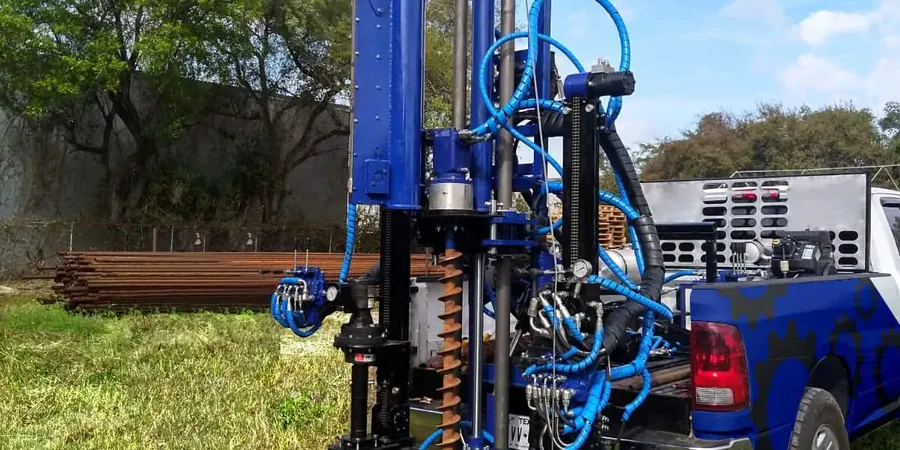
SPT testing in Bedford requires a disciplined approach to the variable geology left by the River Great Ouse. The valley floor alternates between gravel terraces, soft alluvium, and the underlying Oxford Clay, meaning a single site can present three distinct stratigraphic challenges within fifteen vertical metres. Our field crews follow BS 5930:2015+A1:2020 procedures rigorously, driving the split-spoon sampler with a 63.5 kg hammer falling 760 mm and recording N-values every 300 mm of penetration. For sites near the Embankment or in the Castle Quarter, where historical fill overlies natural deposits, we often pair the SPT program with Atterberg limits to distinguish reworked clay from intact Oxford Clay, preventing misclassification that leads to underestimated settlement. The resulting N60 energy-corrected profiles feed directly into bearing capacity calculations under BS EN 1997-1:2004, giving structural engineers the parameter confidence they need for pad footings and pile groups in Bedford's post-glacial landscape.
In Bedford's Ouse Valley, an SPT refusal at four metres is often a gravel lens, not bedrock — misreading that difference can double a foundation budget.
Methodology applied in Bedford
Risks and considerations in Bedford
The contrast between Bedford's northern chalk slopes and the central floodplain is stark. In Brickhill, SPT N-values in chalk till often exceed 50 below three metres, giving contractors confidence for shallow pad foundations. Move two kilometres south to the Priory Country Park area, and N-values in soft alluvial silts can drop below four across a two-metre band, signalling a real liquefaction hazard under seismic loading — even in the UK's low-seismicity setting, BS EN 1998-5 requires assessment when undrained shear strength falls below 15 kPa. Overlooking this lateral variability leads to differential settlement that cracks masonry within the first five years. When SPT profiles indicate liquefiable layers, we supplement the investigation with liquefaction assessment using the NCEER methodology, correlating fines content from wash-through analysis with cyclic resistance ratios. For deep foundations in these soft zones, the N-value profile guides the selection between driven piles and vibrocompaction as a ground improvement pretreatment, with target N1(60) values specified before structural loading begins.
Our services
Our Bedford SPT investigation packages are designed to answer the specific questions raised by the Ouse Valley geology, from gravel thickness mapping to Oxford Clay strength profiling.
SPT Borehole Logging & N60 Profiling
Complete drilling, sampling, and energy-corrected N-value reporting for foundation design. Includes field classification of every recovered sample and digital log delivery within five working days.
Combined SPT & Laboratory Testing Suite
Disturbed samples from each SPT drive tested for particle size distribution, Atterberg limits, and moisture content. Correlates index properties directly with penetration resistance for soil behaviour type classification.
Liquefaction Screening & Ground Improvement Design
SPT-based liquefaction potential analysis using NCEER methodology for sites in Bedford's floodplain. Provides cyclic resistance ratio profiles and, where required, post-compaction target N-values for vibro replacement or dynamic compaction.
Quick answers
How much does an SPT investigation cost for a residential extension in Bedford?
For a typical domestic extension requiring two boreholes to 6–10 metres depth with SPTs at 1.5-metre intervals and a factual report, the cost ranges between £400 and £540. The final figure depends on access constraints, traffic management in conservation areas like the Castle Quarter, and whether disturbed samples need laboratory classification.
How many SPT boreholes does BS 5930 recommend for a site in Bedford?
BS 5930:2015+A1:2020 does not prescribe a fixed number; it depends on site area, geological variability, and the structure's consequence class. For a single dwelling on the Oxford Clay, two boreholes at opposite corners are typical. For a commercial building on the Ouse gravel terraces, we recommend a grid of three to five boreholes, with closer spacing where the desk study identifies buried channels or historical quarries.
Can SPT refusal in the Oxford Clay be used to confirm bedrock for pile termination?
SPT refusal (N>50 over 300 mm penetration) in the Oxford Clay does indicate very stiff to hard consistency, but it does not automatically confirm bedrock. The Oxford Clay is a stiff overconsolidated deposit, not a true rockhead. Pile termination criteria should be based on the cumulative penetration resistance profile and confirmed by at least one deeper borehole penetrating into the underlying Kellaways Formation to prove the full thickness of the clay and rule out soft interbeds.